PAcalculate is a free multi-lingual multi-platform mobile app with calculators and other information and utilities for sound reinforcement and lighting professionals. Current PAcalculate is available for iOS/iPadOS (Apple) and Android from their respective app stores. The application uses responsive design to adapt to work on mobile phones as well as tablets. Both metric and English units are supported.
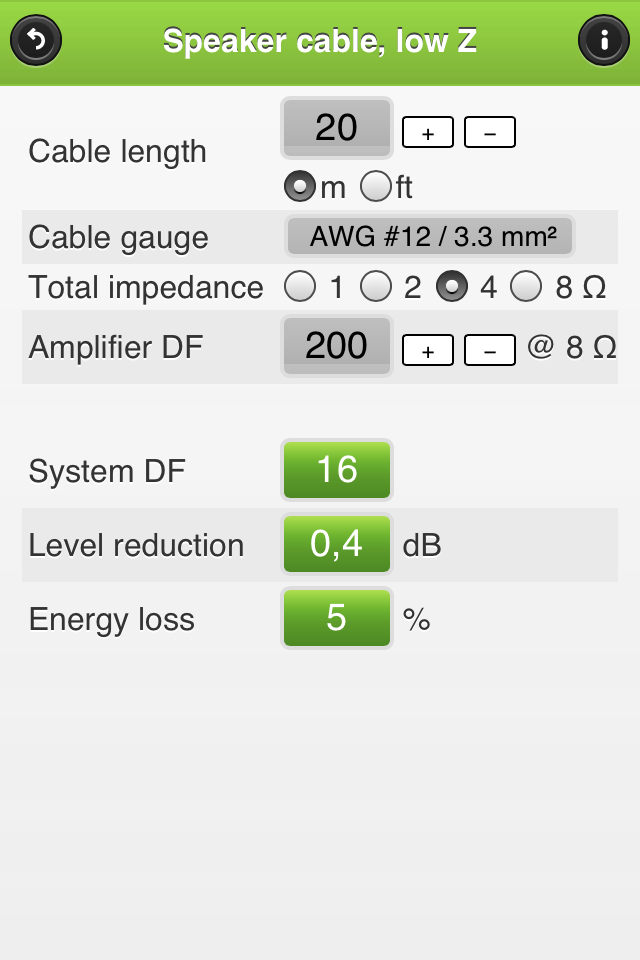
PA related calculators include SPL, SPL addition, ceiling speaker coverage, air absorption, time to distance (and vice versa), frequency to wavelength (and vice versa), subwoofer array simulation, Q factor to bandwidth conversion, dBu-dBV-Volts and cable losses (low and high impedance). For lighting, a DMX calculator as well and RGBW and CMY LED emulations are provided. All calculators provide comprehensive options as well as built-in help. Other calculators are not directly related to the industry, but will nonetheless be useful: Ohm's / Joule's Law, KVA, BPM to time and conversion of weighs and measures.
In addition to calculators, pin assignment information is provided for some of the most common audio and lighting connectors. Lastly, an inclinometer utility rounds up the feature set.
At the time of writing this, PAcalculate comes with English, French, German, Italian, Portuguese, Russian, Chinese (simplified) and Spanish language sets. I am seeking translations to Arabic, Japanese and Korean. Please use this web's contact form if interested.
Windows-Phone 8.0 (Frozen, only English on some models; users of 8.1 will need version 8.10.14219.0 or above) and Windows 10 Mobile. Store kaputt
Blackberry (OS 4-7, models from 8100 to 9981. The BB OS app is frozen at v1.0.4 and will no longer be updated, though, for newer versions, Blackberry10 should easily install Android apps and older BBs might be able to used converted Android files). Store kaputt
webOS and Symbian; apps for older versions can be provided on request
Or simply look for "PAcalculate" on your device
or use this QR code:
We'll be listening
carefully to user feedback on PAcalculate. We've created a Facebook page (facebook.com/pacalculate) as an
area for constructive discussions on current and future features
Translation credits (many thanks!):
Pierrick Saillant (French)
Oliver Baumann (German)
Anton Dudarev (Russian)
Manlio Bonfadini (Italian)
Red bass drum
Shaped tone bursts are used to check maximum levels for individual frequency bands; they are also useful for evaluating distortion performance and even polarity checking. Siegfried Linkwitz (yes, the same Linkwitz that goes with Riley) started using these pulses in the early 80s. Don Keele later refined the concept by defining the window that made the pulses be almost exactly one third-octave wide in frequency as well as developing composite bursts made up of bass frequency pulses. Tomlinson Holman (as in THX) would also advocate the use of tone bursts and incorporated them into his test disks for the Hollywood industry coining the term "boink tests".
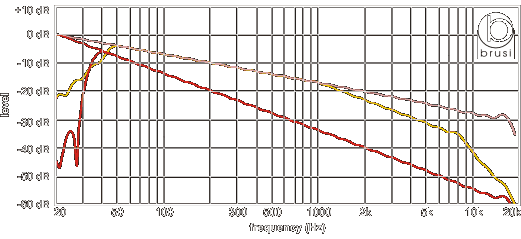
My contribution here takes the form of what I call "9-yard shaped tone bursts", a combination of third-octave band pulses spanning the complete audio spectrum and added together in a controlled way such that different shades or "colors" can be achieved such as white, pink or red (brownian). The illustration shows 131072-point FFT spectra of some of these full-range composite sinewave pulses in pink, red and EIA-426B (shown in yellow) "colours". Additionally, the "red bass drum" limits the "red" burst spectrum to 40 Hz on the low frequencies.
Out of these 9-yard bursts, the "red bass drum" (in Spanish, bombo rojo) can be downloaded from here (
431K
,16 bit 44.1 kHz). Newer browsers with HTML5 support will also show a player. The file has been padded with silence up 5 seconds, for sensible looping. It is a kind of laboratory (yet highly musical) bass drum (except that it does not have harmonics as such, but all frequencies from 40 to 20k Hz, just like noise would), with a "red" shaped spectrum; we think this is a great signal for an instant all-round loudspeaker system check (play either left or right channel only).
(Red bass drum sound licensed under this Creative Commons License)
Whalebone & Idling spaceship
While making some test sounds i wondered what a large bunch of
logarithmically spaced tones spanning the audible band would sound
like. As a synthesist, i have always enjoyed designing highly
modulated sound textures using a music synthesizer. However, i never
thought mathematically generated steady-state sounds could provide
much liveliness, but here are whalebone and idling spaceship to prove me wrong.
They are like the picket fence sound (same thing with one tone per 1/3rd
octave band) on steroids.
Using the same 1/24th octave resolution
i often use for measurements, you get a highly modulated sound that i (following the picket
fence analogy on an inspired moment) named whale bone, since a whale's
baleen (also referred to as "whale bone") is made up of an average of 260 plates,
which happens to be extremely close to the 248 frequencies i use to
cover the 1/3 octave bands from 20 to 20k Hz at 8 tones per 1/3rd
octave bands, i.e. 24 tones per octave).
The sound can be downloaded from here. For lightness,215K,
it is presented in mono, using 8 bits and with a
sampling frequency of 22 050 Hz (so there are tones to 11 kHz only). HTML5 capable browsers will show a player below.
Along the same route we find idling spaceship. Here we increase the tone density and generate around 2000 tones up to 20 kHz. The result is a sound that develops over time and can be downloaded from here (646K, also 8-bit/22k Hz). Again, HTML5 capable browsers will show a player below.
Those last two are probably useless "pink" coloured sounds, but I thought they were amusing.
(The two wave files above are licensed under this Creative Commons License)
Piston animations
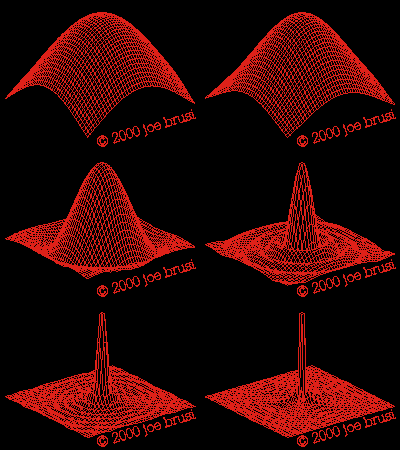
The animation below shows the directivity for a cone loudspeaker which has been simulated as a piston. The resulting radiation patterns come from Bessel functions, and can be seen to beam as frequency increases
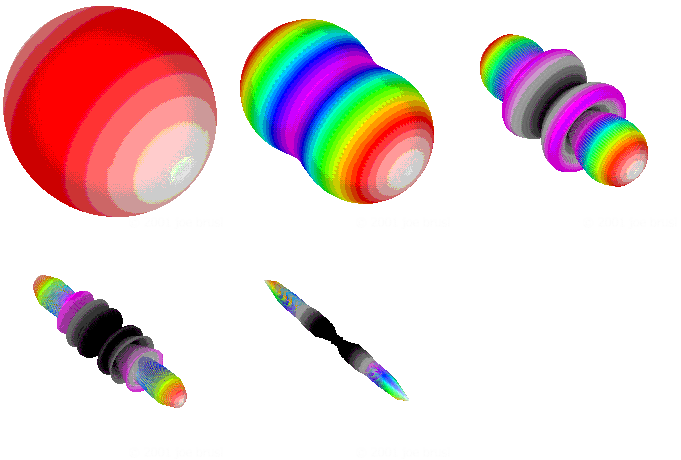
The animation below also shows the directivity for a cone loudspeaker which has been simulated as a piston, but is represented as 3D directivity balloons.
Lobing is more clearly visible since a dB representation is used.
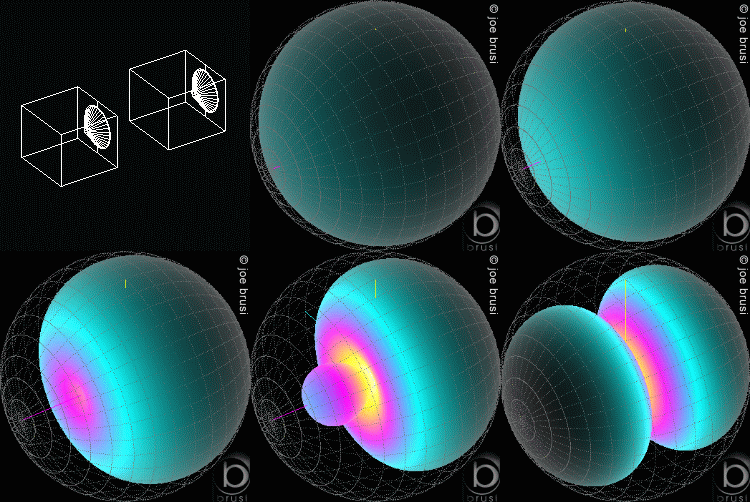
The animation below also shows the directivity for a 2-element end-fire array. Balloons go from omnidirectional through all cardioid flavours to figure of eight.
Articles
The following online
versions of some of my articles can be found on the web:
Loudspeaker directivity, published by Sound and Video Contractor magazine (USA) in
April 1999.
The online version only contains partial text and does not include the numerous illustrations, but an updated version can be found here. PDF en español (original spartan PDF in Spanish)
The Power Alley published
by Live Sound International and LiveAudio.com / ProSoundweb.com in 2003. Ignore the Sound and Video Contractor version if you ever see it, as some nonsense was unfortunately added to my original text. This one became a popular piece that keeps getting reprinted to this day; despite left-right subwoofer interactions being very apparent in outdoor applications and the explanation for the power alley being far from being rocket science, nobody had actually sat down to extensively describe the effect, probably partly because subwoofer modelling was not available at the time (I had to use dimensional analysis and some custom speaker directivity and wireframe files). PDF en español (original spartan PDF in Spanish)
Electronic Versus Physical: An Analysis Of Shaping Array Directivity published by Live Sound and ProSoundweb.com in 2011. It explains why steering or arcing an array yields completely different results when done electronically (using delay) and physically. Case studies are provided to illustrate caveats for each depending on the application. PDF en español (original PDF in Spanish)
Assessing The Impact: The Effect Of Cupping On Cardioid Microphone Directivity published
by Live Sound International and ProSoundweb.com in June 2020. The article shows how cupping reduces vocal microphone directionality. En español
Say What? The Impact Of Masks On Speech Intelligibility published
by Live Sound International and ProSoundweb.com in April 2021. The article the effect of facemasks on frequency response and suggests corrections.


 iOS (Apple's iPhone, iPad and iPod-touch) :
 We'll be listening
carefully to user feedback on PAcalculate. We've created a Facebook page (
We'll be listening
carefully to user feedback on PAcalculate. We've created a Facebook page (